
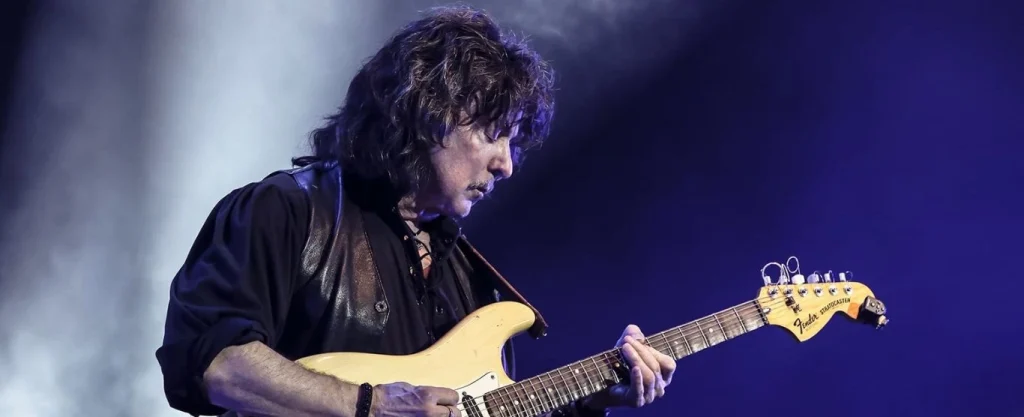
Legendary guitarist Ritchie Blackmore has opened up once again about the real reasons behind his departure from Deep Purple, explaining that by the mid-1970s the group had lost the spirit that originally made it one of the most influential rock bands in the world.
Speaking in a recent interview, the founder of Rainbow reflected on the moment when he realized it was time to move on. For Blackmore, the issue wasn’t simply musical disagreements—it was a deeper feeling that the chemistry and shared focus that defined the band’s golden era had disappeared.
According to the guitarist, the situation within Deep Purple had gradually shifted away from being a tight-knit rock group toward something far more fragmented. Members were increasingly occupied with individual interests and external commitments, which made it difficult for the band to function as a unified creative force.
Blackmore explained that at one point he looked around and felt the band no longer behaved like a band at all. In his view, the group had turned into “a collection of people with business interests and separate plans,” rather than musicians fully dedicated to working together.
Another key moment that reinforced his frustration came during a songwriting discussion. Blackmore reportedly suggested performing a song written by someone outside the band, only to hear a dismissive response from a fellow member who argued there was no reason to play it if they wouldn’t receive writing credits. That reaction disappointed the guitarist and reinforced his belief that the artistic focus had been replaced by financial considerations.
The Breaking Point
These growing tensions unfolded during the era surrounding the 1974 album Stormbringer. While Deep Purple remained hugely successful, the band was navigating stylistic changes and internal disagreements. The lineup had already shifted, with new influences entering the group’s sound—something Blackmore increasingly felt disconnected from.
By 1975 he made the decision to leave the band. Rather than continue in a situation that felt creatively restrictive, Blackmore chose to start a completely new project.
The Birth of Rainbow
Soon after leaving Deep Purple, Blackmore formed Rainbow alongside vocalist Ronnie James Dio and members of the band Elf. The new group allowed him to pursue a heavier, more fantasy-driven style of rock that blended classical influences with powerful hard-rock songwriting.
For Blackmore, Rainbow represented a fresh start and a return to making music purely for enjoyment. The guitarist later said that once he began working with the new band, he rediscovered the excitement he felt in his early years as a musician. Music became fun again—something he felt had been fading during his final period in Deep Purple.
A Complicated Legacy
Despite leaving the band, Blackmore’s influence on Deep Purple remains monumental. His riffs and compositions helped define the sound of classic albums like Machine Head, and his guitar work continues to inspire generations of rock and metal players.
Interestingly, the story didn’t end with his initial departure. Blackmore eventually rejoined Deep Purple in the 1980s for the reunion album Perfect Strangers, though tensions would resurface later, leading to his final exit in the early 1990s.
Today, his legacy spans multiple iconic projects—from the pioneering hard rock of Deep Purple to the epic sound of Rainbow, and later the medieval-inspired music of Blackmore’s Night.
Even decades later, his reflections reveal how deeply he values the idea of a band as a creative brotherhood. When that feeling disappears, Blackmore suggests, something essential about the music disappears too.