
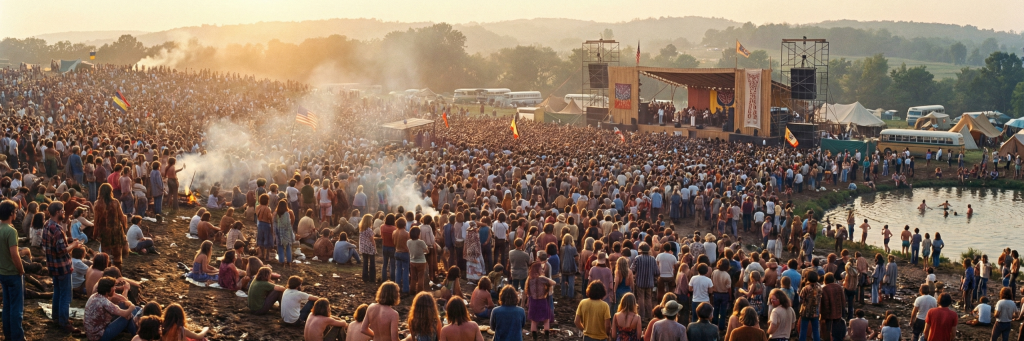
Woodstock is often remembered as a peaceful gathering of music, love, and unity. Three days that defined a generation. Half a million people. Legendary performances. A cultural turning point.
But the real story of Woodstock is far more chaotic, risky, improvised, and human than the polished myth we usually hear. Behind the flower crowns and guitar solos was a festival that nearly collapsed multiple times—and somehow became immortal anyway.
This is what no one really tells you about Woodstock.
It Was Never Meant to Be “Free”
Woodstock was planned as a paid music festival. Tickets were sold in advance, fences were built, and security was hired.
Then tens of thousands of people arrived early.
The fences were torn down before the gates officially opened, making ticket control impossible. At that moment, the organizers had only two choices: shut the festival down entirely or let it happen.
They chose chaos.
Woodstock became a free concert not by ideology, but by logistical surrender.
The Crowd Size Was a Massive Miscalculation
Organizers expected around 50,000 people.
What they got was closer to half a million.
This wasn’t just an inconvenience—it was a serious threat. Food ran out almost immediately. Medical staff were overwhelmed. Sanitation systems were never designed for that scale.
The fact that the festival didn’t turn into a full-blown disaster is still considered a miracle by event safety standards.
Rain Turned the Festival Into a Survival Test
When the rain started, Woodstock stopped being a concert and became a test of endurance.
Fields turned into mud. People slept soaked, cold, and hungry. Electrical equipment was constantly at risk. Performances were delayed or stopped entirely to prevent electrocution.
Yet instead of panic, the crowd adapted. People shared blankets, food, and shelter. The mud became part of the experience—and later, part of the legend.
Artists Played Under Extreme Conditions
Many of the musicians performed after hours or days of waiting, often with little rest and unclear schedules.
Some artists played in daylight when they were meant to play at night. Others went on stage exhausted, unsure if the sound system would even hold.
Jimi Hendrix’s iconic performance didn’t happen at the festival’s peak—it happened on the final morning, after much of the crowd had already left. What remained was a smaller, drained audience witnessing one of the most influential performances in rock history.
Medical Emergencies Were Constant
Despite the “peace and love” narrative, Woodstock faced real danger.
There were drug overdoses, injuries, and medical crises happening continuously. Volunteer doctors and nurses worked non-stop with limited supplies. At times, helicopters were the only way to transport people who needed urgent care.
The low number of fatalities is often cited as proof of Woodstock’s spirit—but it was also the result of pure improvisation and human effort.
The Sound System Was a Technical Gamble
The sound system at Woodstock was groundbreaking but fragile.
Delays, feedback issues, and power problems were common. Crew members had to constantly repair equipment under rain and mud, often minutes before artists went on stage.
Modern festival production owes a lot to Woodstock—not because it was perfect, but because it exposed everything that could go wrong.
Woodstock Became a Myth After It Ended
At the time, Woodstock was not universally seen as a success.
Financially, it was a mess. Logistically, it was a nightmare. Critics questioned whether such an event should ever be attempted again.
What transformed Woodstock into a legend wasn’t just the music—it was the story told afterward. Films, photos, and memories shaped it into a symbol of unity, even though the reality was far messier.
Woodstock didn’t prove that people are perfect.
It proved that, under pressure, people can choose cooperation over collapse.
Why Woodstock Still Matters
Woodstock matters not because it was flawless, but because it wasn’t.
It showed that music can hold people together even when systems fail. That community can emerge from disorder. That a concert can become a cultural moment not by design—but by accident.
And that’s the part history often forgets.