
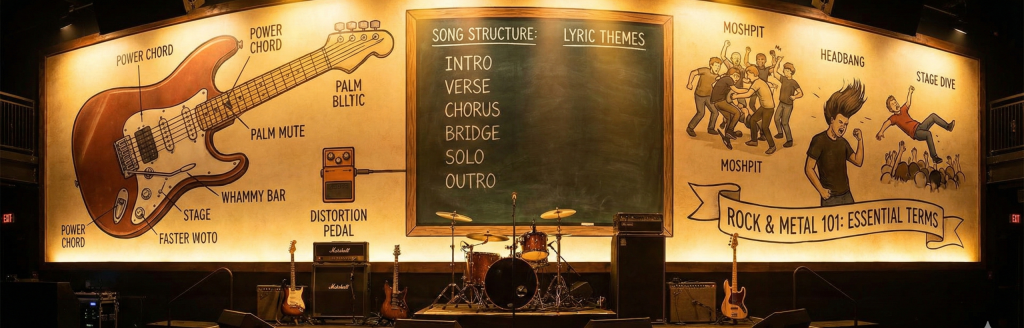
Rock and metal have their own language. You don’t need to play an instrument to feel it, but understanding the words behind the sound makes every riff, solo, and breakdown hit harder. Here’s a guide to the most important rock and metal terms, explained in a clear, fan-friendly way—no music theory degree required.
Riff
A riff is a short, repeated guitar phrase that forms the backbone of a song. It’s usually the part you recognize instantly—the moment that makes your head nod before the vocals even start.
Riffs are often simple, powerful, and memorable, built to lock into your brain and stay there. Entire songs can revolve around a single great riff.
Breakdown
A breakdown is a section where the song slows down or strips back to focus on rhythm and impact rather than melody.
In metal and hardcore, breakdowns are designed to hit physically—heavy palm-muted guitars, tight drums, and a pulse that invites headbanging or moshing. It’s less about complexity and more about controlled aggression.
Palm Muting
Palm muting is a guitar technique where the player rests the edge of their picking hand lightly on the strings near the bridge.
The result is a tight, chunky, percussive sound that gives rock and metal their signature heaviness. Without palm muting, many classic riffs would lose their punch.
Power Chord
Power chords are simplified chords built using just two or three notes.
They sound big, aggressive, and clear—especially with distortion—which is why they became the foundation of rock, punk, and metal guitar playing. If a song feels massive but straightforward, power chords are probably doing the heavy lifting.
Hammer-On
A hammer-on happens when a guitarist plays a note and then presses another finger onto the fretboard without picking again.
This creates a smooth, fluid sound and allows faster passages without extra picking. Hammer-ons are essential for expressive solos and melodic runs.
Pull-Off
The opposite of a hammer-on. A pull-off involves plucking a note by pulling the finger off the string to a lower note.
When combined with hammer-ons, pull-offs create fast, flowing lines that feel almost vocal in nature.
Solo
A solo is a featured instrumental section, usually played on guitar, where melody and emotion take center stage.
Solos can be flashy and technical, slow and soulful, or raw and chaotic. In rock, solos aren’t just about speed—they’re about personality.
Bridge
The bridge is a contrasting section that breaks the repetition of verses and choruses.
It often introduces new chords, rhythms, or moods before returning to familiar territory. A great bridge can completely change how a song feels without breaking its identity.
Tempo
Tempo refers to how fast or slow a song is.
Fast tempos tend to feel aggressive, urgent, or energetic, while slower tempos often feel heavier, darker, or more emotional. Changing tempo within a song is a powerful way to shape its intensity.
Distortion
Distortion alters the guitar’s sound, making it rougher, louder, and more saturated.
It’s one of the defining elements of rock and metal, adding sustain and harmonic richness that clean tones simply can’t deliver.
Why This Matters
Knowing these terms doesn’t just make you sound informed—it deepens how you experience music.
You start to notice why a song feels heavy, why a riff sticks, or why a breakdown hits like a punch to the chest. Rock isn’t just noise—it’s structured chaos, and every term is a key to understanding it.