
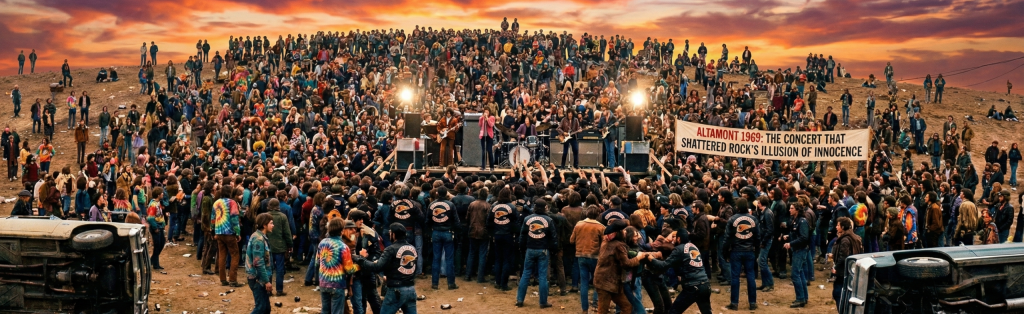
Altamont was meant to be the West Coast’s answer to Woodstock.
A free concert. Massive bands. A celebration of peace.
Instead, it became the moment rock music lost its innocence.
A Festival Built on Bad Decisions
From the beginning, Altamont was rushed, underplanned, and unstable.
The venue changed at the last minute. The stage was too low. Crowd control was nearly nonexistent. And in a decision that would prove catastrophic, the event hired members of the Hells Angels as security.
They were paid in beer.
Violence Was Visible—and Ignored
As the day progressed, aggression escalated. Fights broke out in front of the stage. Weapons were visible in the crowd.
Artists saw it. Organizers saw it. The show went on anyway.
By the time the Rolling Stones took the stage, tension was already boiling over.
A Death in Front of the Stage
During the Stones’ set, a young man was killed near the stage.
The music didn’t stop immediately. Confusion reigned. Fear spread through the crowd. What was meant to be a celebration turned into trauma.
Altamont wasn’t just a tragedy—it was a warning.
The End of the 1960s Dream
Altamont symbolized the collapse of the idealism that defined the decade.
Peace, love, and music proved fragile under poor planning and unchecked power. Rock was no longer just rebellion—it carried responsibility.
Why Altamont Still Matters
Altamont forced the music industry to take safety seriously.
It changed how concerts were organized forever. And it reminded the world that music alone cannot hold chaos at bay.